The Mackinaw Bridge was first conceptualized in 1889 after the completion of the Brooklyn bridge the year before, and after half a century and countless hurdles Michigan's two peninsulas were connected. At the time of its completion it was the longest suspension bridge at 5 miles, today it is still considered a superstructure. Designed by David B. Steinman the Mighty Mac took just over 3 years and almost $100 million to build.
My personal connection with the Mackinac bridge goes back to elementary school when my family would drive to the UP every summer and the best part of the commute was always crossing the bridge. During grade school the summer trips turned into winter trips and crossing the bridge became more dangerous. Still I was amazed at the rigidity and flexibility the bridge showed.
As for the bridge itself, well it is still a modern marvel. In 1999 the Big Mac was named as the biggest civil engineering accomplishment of the century for the state of Michigan. The design of the bridge was directly influenced by the failure of the Tacoma Narrows Bridge. Engineer David B. Steinman recommended deeper trusses to decrease wind resistance and increase stiffness. When Steinman was appointed as the head engineer he incorporated his theories and when the bridge was completed it was the first long span suspension bridge with features like, a porous deck to increase aerodynamics.
The world is constantly improving, but if a structure is built right it will stand the test of time and these changes. The Mackinac Bridge is a perfect example of this as it is still one of the greatest bridges in america today. In the future I can only hope to work on a project half this size.
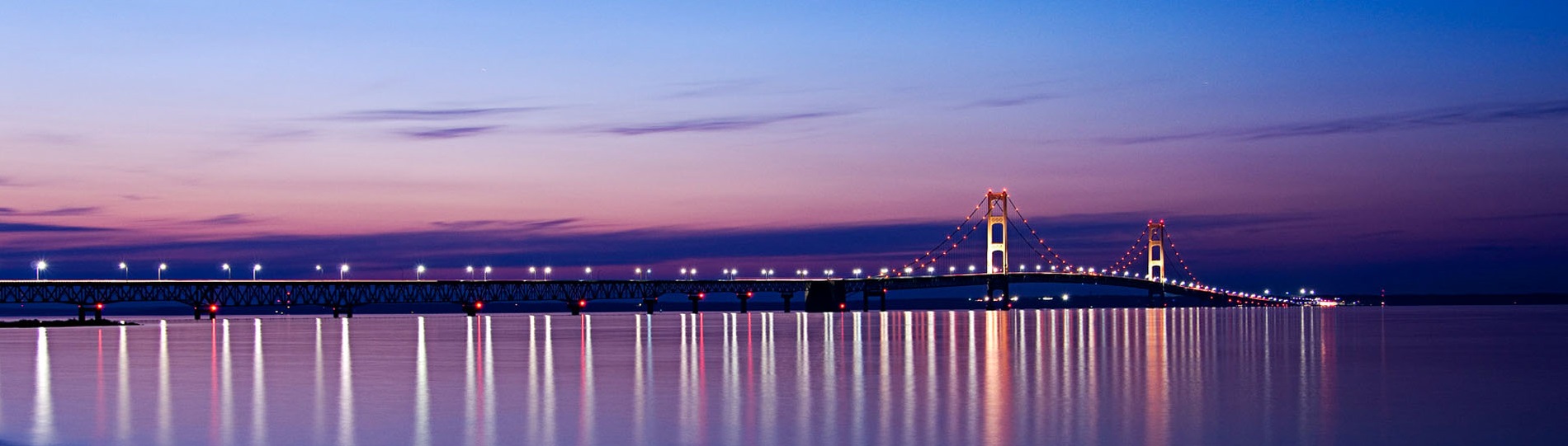 |
| The Mackinac Bridge: http://www.mackinacbridge.org/wp-content/uploads/2016/10/DI-02213-0042-slideshow.jpg |
- Watanabe, Kenji. "Mackinac Bridge." Mackinac Bridge | ASCE. ASCE, 2010. Web. 30 Jan. 2017.
- "History of the Bridge, Mackinac Bridge." Mackinac Bridge Authority. MDOT, 2017. Web. 30 Jan. 2017.

No comments:
Post a Comment